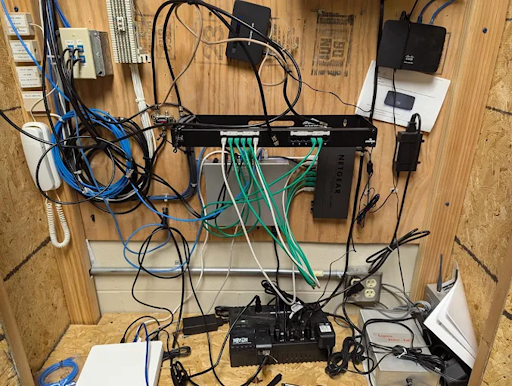

Broadband officials in North Carolina, South Carolina, and Georgia have spent the last several years focused on getting fiber into the ground. Maps were drawn, challenge processes were run, and construction contracts were awarded to companies that know how to trench cable and hang it on poles. That work is still underway in all three states. But a second, quieter phase of the Broadband Equity, Access, and Deployment program is now taking shape, and it asks a different question than the one construction contracts were built to answer: once a network reaches a library, a housing authority, or a city hall, who keeps it running?
The scale of what remains outside of construction is significant. South Carolina’s program has narrowed to eight remaining subgrantee projects, with roughly $510 million still unallocated and awaiting federal guidance. North Carolina has committed only a portion of its $1.53 billion BEAD allocation to construction, leaving close to $1.21 billion tied to non-deployment categories such as cybersecurity, resiliency, and workforce development. Georgia is moving through a similar federal review process. In each case, a meaningful share of the money still on the table has nothing to do with laying fiber and everything to do with what happens afterward.
That distinction is not academic. A construction contract has a defined end point. Network operations do not.
Once a fiber build wraps, someone has to monitor the network, respond when a connection drops, secure it against intrusion, and meet the ongoing compliance and accountability requirements attached to federally funded infrastructure. Those obligations run for years, not months, and they call for a different kind of vendor than the one that won the construction bid. Procurement conversations in the Southeast that once centered almost entirely on construction capacity are now touching on operational history, security practices, and long-term support capability.
A Company That Predates the Program
Anaptyx LLC, a managed Wi-Fi provider headquartered in Myrtle Beach, has been doing this kind of work since 2007, nearly two decades before BEAD existed. The company’s business has centered on designing and operating wireless networks rather than building fiber infrastructure, and its leadership treats that as a meaningful distinction. Anaptyx is not attempting to break into municipal broadband because of BEAD funding. It has already spent most of two decades doing the operational work this next phase of the program requires.
That history comes with two credentials relevant to public-sector procurement. Anaptyx holds a General Services Administration Multiple Award Schedule contract, an established federal contracting vehicle that state and local governments can use as one available path for procuring qualified vendors. It does not eliminate a jurisdiction’s own competitive procurement requirements, but it is the kind of pre-vetted status agencies weighing new broadband partners tend to view favorably. Anaptyx is also a certified small disadvantaged business, a designation that can support workforce and small-business participation goals written into several states’ BEAD plans.

What Happens After the Fiber Is Lit
The platform behind Anaptyx’s operations work is called Beyond Wi-Fi, built to handle more than internet access. Connectivity, streaming television, security cameras, electronic access control, and Wi-Fi-based smart locks run on the same managed network rather than through separate vendor contracts. For a municipality, that consolidation solves a specific administrative problem. Instead of coordinating three or four vendors when something fails, there is one company accountable for the whole system.
The platform is offered across three tiers, Essential, Essential Plus, and Premium, scaling from connectivity and threat protection through television service up to a full deployment with custom security camera integration. A small town hall and a housing authority campus rarely have the same needs, and the tiered structure is built to reflect that.
Segmentation is the more technical piece of the story, and one closely tied to the cybersecurity and compliance expectations attached to federally funded networks. Beyond Wi-Fi keeps administrative systems, public safety communications, camera feeds, and public or guest Wi-Fi on logically separate segments of the same network rather than one flat structure. Combined with DNSFilter’s threat protection running at the network level rather than only at the perimeter, that architecture aligns with what cybersecurity reviewers generally look for when assessing whether a federally funded network is being operated responsibly.
Anaptyx has also built a record of independent recognition. The Leader Report recently named Beyond Wi-Fi the best managed Wi-Fi platform in the country, and the company has been voted Myrtle Beach’s best internet service provider three years in a row, from 2022 through 2024. Behind both distinctions sits the same 24/7/365 support desk, manned by experienced Field Technicians, Engineers, and Network Administrators working with an Anaptyx copyrighted and proprietary monitoring system, that already answers calls from the company’s municipal, housing authority, and hospitality clients.
A Partner to the Builders, Not a Competitor
Anaptyx is careful about how it frames its role in the BEAD landscape. It is not competing for construction awards. Companies such as ZiTEL and TruVista Communications are already winning fiber contracts in South Carolina, and their networks will still require indoor distribution, segmentation, and ongoing operational support once construction ends. That is the gap Anaptyx is positioning itself to fill, working alongside the builders rather than against them.
The Argument Behind the Book
Anaptyx’s COO, Kenneth Carnesi, Sr., has made a version of this same argument in a different form. His book, The Future of Bulk Wi-Fi, currently nominated for the 2026 Goody Business Book Awards, was written for an audience of property managers, HOA boards, and facility leaders who are increasingly responsible for decisions about connectivity without necessarily having a technical background to draw on. Its central premise is that bulk Wi-Fi has stopped functioning as a simple utility and started functioning as infrastructure, the kind that requires planning, accountability, and long-term management rather than a one-time installation.
That premise maps onto what is now happening inside BEAD. As construction winds down in the Carolinas and Georgia, state broadband offices are being asked, in effect, the same question Carnesi’s book poses to a hotel operator or an HOA board: is this network being treated as infrastructure someone is accountable for, or as a utility that simply exists once it’s turned on? The public-sector version of that question carries higher stakes and more oversight, but the underlying logic is the same one Carnesi has spent his career applying to Anaptyx’s own client base.
None of this guarantees that Anaptyx will be the operations partner every municipality in North Carolina, South Carolina, or Georgia selects. But the shift in where BEAD dollars are now headed, toward operations, cybersecurity, and long-term accountability, has changed the kind of vendor these states are looking for. The construction phase answered the question of whether a network could be built. What remains is the harder question of who keeps it running, secured, and accountable for the decade of service obligations that follows. That is a different hire than the one most municipalities made the first time around.