
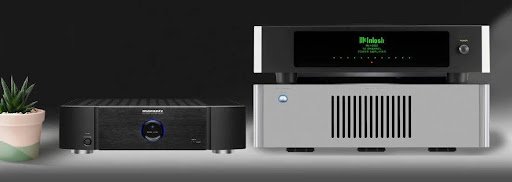
Home theatres have become an integral part of modern living, providing a private and immersive cinematic experience within the comfort of our homes. While advancements in visual technology have taken centre stage, audio quality plays an equally crucial role in elevating the overall movie-watching experience. In the realm of audio enhancement, power amplifiers stand out as indispensable tools for audiophiles and home theatre enthusiasts alike.
What are Power Amplifiers?
A power amplifier is an electronic device that boosts the power of a given input signal. Unlike voltage or current amplifiers, a power amplifier is specifically designed to directly handle loads and typically serves as the final stage in an amplifier chain.
Solid-state amplifiers use semiconductor devices for signal amplification, offering efficiency and reliability. On the other hand, tube amplifiers employ vacuum tubes, known for their warm and harmonically rich sound.
For a Power Amplifier to work effectively, the input signal must meet a certain threshold. Instead of sending the raw audio or RF signal directly to the power amplifier, it undergoes pre-amplification using current or voltage amplifiers. After necessary modifications, this pre-amplified signal is then sent as input to the power amplifier.
Benefits of Using Power Amplifiers for Speakers
Investing in power amplifiers for speakers can yield many benefits. Some of these benefits are:
- Sound Quality: One of the most noticeable advantages is the improved audio clarity and detail. Power amplifiers ensure that every nuance of the audio signal is faithfully reproduced, allowing you to catch subtleties in dialogues, background sounds, and musical scores that might otherwise be lost.
- Enhanced dynamic range: This is another key benefit. High power amplifiers contribute to a broader range between the softest and loudest sounds, creating a more immersive and realistic audio experience. This is particularly crucial in home theatres where a faithful representation of a movie’s audio dynamics can significantly enhance the overall cinematic impact.
- Better Bass: Moreover, power amplifiers play a vital role in delivering better bass response. Low-frequency sounds, such as deep rumbling in action scenes or the subtle thud of a bass guitar, are rendered with greater precision and impact. The result is a more visceral and engaging experience that can be felt as much as heard.
- Lesser Distortion: Reduced distortion is perhaps one of the most critical contributions of power amplifiers. Distortion can muddy the audio quality, detracting from the immersive experience a home theatre is meant to provide. Investing in a quality high power amplifier minimises distortion, ensuring that the audio reproduction remains faithful to the source material.
Selecting the Right Power Amplifier for Your Home Theatre
Choosing the right power amp involves careful consideration of various factors. Matching the amplifier’s power with the speakers is paramount, as an underpowered amplifier may lead to distortion, while an overpowered one could damage the speakers.
Compatibility with AV receivers is another crucial consideration, as some power amps may work seamlessly with specific receivers, while others may require additional adjustments.
Budget considerations play a role, too, with a wide range of amplifiers available at different price points. It’s essential to find a balance between your budget and the desired audio quality. Additionally, researching brand reputation and reading customer reviews can provide valuable insights into the performance and reliability of a particular amplifier.
Installation and Setup Tips
Once you’ve selected the right power amplifier for your home theatre, proper installation and setup are crucial to maximising its potential. Consider the placement of the amplifier, ensuring proper ventilation to prevent overheating. Connecting the amplifier to your AV receiver and speakers requires attention to detail, following the manufacturer’s guidelines for optimal performance.
Calibration and optimization are the final steps in the setup process. Many amplifiers come with built-in calibration tools or can be paired with external devices to fine-tune the audio settings. Taking the time to calibrate your system ensures that the power amplifier works seamlessly with your speakers, delivering an immersive and balanced sound experience.
Final Thoughts
Power amplifiers play a pivotal role in elevating the audio quality of home theatres, contributing to a truly immersive cinematic experience. The benefits of enhanced clarity, dynamic range, bass response, and reduced distortion are compelling reasons to consider integrating a power amplifier into your audio setup.
By understanding the different types of amplifiers, selecting the right one for your needs, and optimising the installation and setup, you can unlock the full potential of your home theatre audio. As technology advances, the future promises even more exciting possibilities for audio enthusiasts seeking to create the ultimate cinematic sound experience in the comfort of their homes.
Frequently Asked Questions (FAQs)
1. What is a power amplifier in a home theatre?
A power amplifier is a device that boosts an audio signal so it can drive speakers effectively. It is typically the final stage in an audio system and ensures that the speakers receive enough power for clear, dynamic sound reproduction.
2. How does a power amplifier differ from a preamplifier?
A preamplifier handles low-level signals, boosting and shaping them before they are sent to the power amplifier. The power amplifier then increases this signal to a level strong enough to power the speakers.
3. What are the main types of power amplifiers?
The two most common types are:
- Solid-state amplifiers – use semiconductor components, known for reliability and efficiency.
- Tube amplifiers – use vacuum tubes, appreciated for their warm, rich, and detailed sound.
4. What benefits do power amplifiers provide for home theatre speakers?
Power amplifiers improve:
- Sound quality and clarity
- Dynamic range, making quiet and loud scenes more realistic
- Bass response with deeper, tighter low frequencies
- Distortion control, ensuring clean and accurate audio reproduction
5. Do I really need a power amplifier for my home theatre?
If you want higher sound quality, better dynamics, improved bass, or your speakers require more power than your AV receiver can provide, then a power amplifier is a worthwhile upgrade.
6. How do I choose the right power amplifier for my speakers?
Match the amplifier’s power output to your speakers’ power handling and sensitivity. Avoid underpowered amps (which cause distortion) and overly powerful ones (which may damage speakers). Also check compatibility with your AV receiver.
7. Are power amplifiers compatible with all AV receivers?
Most AV receivers with pre-out connections support external power amplifiers. However, some models require specific configurations, so always check your receiver’s specifications before purchasing.
8. Where should I place my power amplifier?
Place it in a well-ventilated area with sufficient airflow. Avoid stacking it with other heat-producing devices, as amplifiers can generate significant heat during operation.
9. How important is calibration when using a power amplifier?
Very important. Proper calibration ensures balanced sound, accurate speaker levels, and optimal performance. Many systems include automatic calibration tools, but manual fine-tuning can further enhance results.
10. Can using a power amplifier damage my speakers?
A mismatched amplifier—too weak or too powerful—can potentially damage speakers. Choose an amplifier whose power output aligns well with your speakers’ recommended range.
11. Do power amplifiers improve bass?
Yes. Power amplifiers supply the necessary energy for low-frequency reproduction, resulting in tighter, deeper, and more impactful bass.
12. Are tube amplifiers better than solid-state amplifiers?
Neither is universally better they simply offer different sound characteristics:
- Tube amps deliver warm, smooth tones.
- Solid-state amps offer accuracy, efficiency, and reliability.
Your choice depends on personal preference and listening style.